Dancing to
Build Society
Beyond the neoliberal world
An embodied, participatory research project exploring how dance can help us imagine more relational, ecological, and liveable futures.
Can dance help us imagine different ways of living and organizing together — with each other, and with the living world?
We are living through a time of profound uncertainty, in which climate disruption, global pandemics and rapidly expanding technologies challenge the ways we understand our place in the world. These crises are not isolated events; they reveal the fragile relationships between human bodies, social systems, technologies and the living Earth.
In this context, the body can become more than an individual instrument or a private resource. It can be understood as a form of ecological intelligence: a living capacity to sense, adapt, listen and enter into relation with others and with the more-than-human world. Through movement, we may learn to perceive differently — to attend to rhythms, interdependencies and forms of knowledge that dominant systems of productivity, control and measurement often overlook.
Dance becomes a practice of somatic inquiry and collective imagination. It allows us to explore how alternative ways of living and organizing might be felt before they are fully articulated. By reconnecting bodily experience with the Earth, with one another and with the futures we are already shaping, this project asks how embodied practices can help us imagine and cultivate more relational, desirable and liveable futures.
This project invites you to reflect on your experience of contact improvisation and dance improvisation, and to collect and share its traces as part of a growing, shared collection.
Through drawings, memories, and speculative stories, it explores how embodied forms of listening, support, and cooperation might inspire more relational, ecological, and liveable futures.
Take part in the research
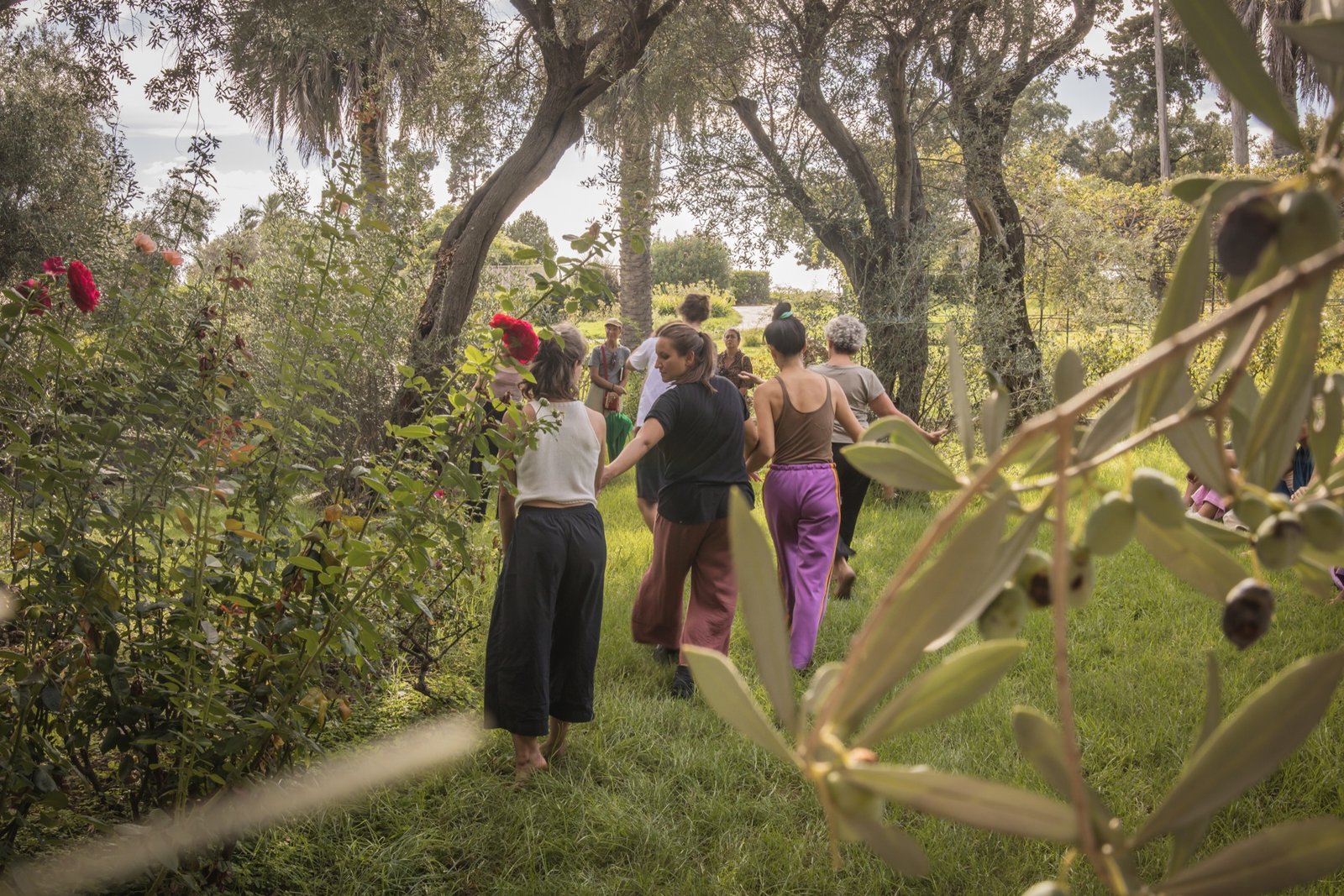
Each of these activities starts from your own experience of contact improvisation or dance improvisation — from a class, a jam, a workshop, wherever you’ve practised it. From there, you are welcome to take part in one, two, or more of these activities — by sharing an audio recording, drawing, photograph, video, or written story. You can mix and match them as you like. You can also respond with a movement instruction or score of your own.
Contributions can be shared anonymously, under a pseudonym, or with your name. They may be written, spoken, or drawn in whatever language feels most natural to you — this collection is not limited to English.
Contributions are gathered on a digital wall: a shared online board hosted on Padlet. The drawings, audio recordings, videos, and stories appear side by side and can be viewed or listened to by other participants. You can see how it works by selecting “Explore the collection” below.
The questions under each activity below are suggestions, not requirements — feel free to follow them, adapt them, or set them aside. Any form of reflection is welcome.
Record an audio
Record a short audio recalling a moment from the dance practice — somewhere between 1 and 3 minutes is a good length to aim for. You might talk about:
- How does your body change when you feel supported by others?
- How can a decision be made without a leader?
- What does it mean to inhabit a non-competitive space?
- What forms of relationship become possible through contact?
- Was there also a moment of discomfort, exclusion or conflict?
What moment from the experience has stayed in your body?
Make a drawing
Create a drawing inspired by the experience. You might draw:
- the form of relationship you perceived;
- a society that could emerge from this way of being together;
- a place where people collaborate without being organized by competition;
- a collective body, a future institution or a new form of community.
Draw the society that could grow from this way of being together. Please add a short explanation — the meaning of the image should come from you.
Write a text
Imagine that the ways of relating experienced through dance become part of a future society. You may consider:
- how decisions are made, and how people work and care for one another;
- how people learn, and how homes and public spaces are organized;
- what happens to hierarchy when people take turns leading and following;
- how people relate to land and the more-than-human world.
It is the year 2045, organized around what you felt in the practice. What is everyday life like? (any form, any length)
More to think about, before or after you contribute
The body can be a starting point for imagining social transformation.
- Which practices from the dance experience could become social practices?
- What could change in work, care, education or relationships?
- How could trust and interdependence become part of collective life?
- What would an organization feel like if it were based on listening rather than control?
- What would it mean to extend that listening beyond other people — to land, other species, ecosystems?
Every practice also has limits and contradictions.
- Did forms of hierarchy or power emerge?
- Who felt able to participate, and who might have been left out?
- What are the limits of imagining society through dance?
- What would need to change for these possibilities to become accessible to everyone?
Where this project comes from
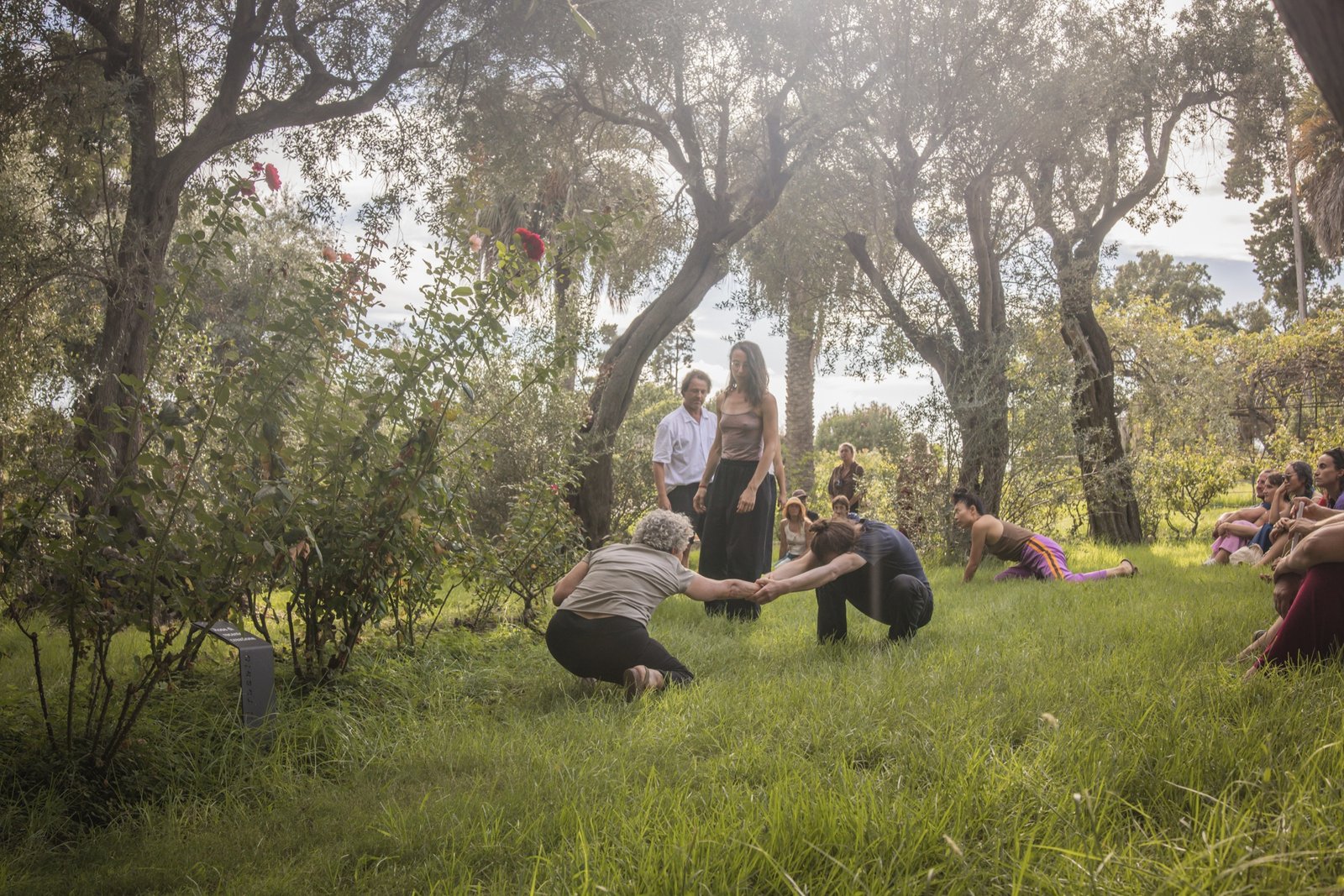
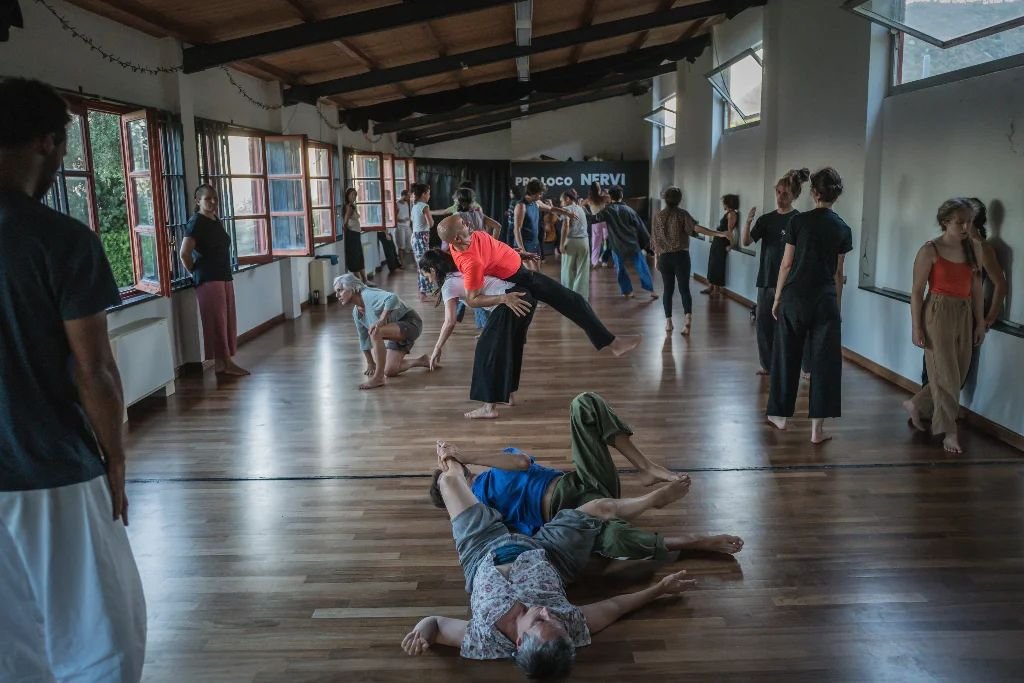
This page grew out of a desire to give voice to our experience as dancers, following the reflections and practices encountered during workshops with Kirstie Simpson and Charlie Morrissey. It explores movement as a way of knowing and relating to the world, while cultivating an awareness of our connection with the Earth and of the importance of care — for ourselves, for one another, and for the more-than-human world.
This project explores how contact improvisation, dance improvisation, and embodied practices can open up different ways of imagining social and collective life.
It begins from the understanding that knowledge does not exist separately from the bodies, environments, and relationships through which it takes form. Sensing, thinking, relating, and imagining are deeply entangled.
In movement, ways of living together are continually shaped through support, attention, rhythm, hesitation, adaptation, and response. Contact improvisation and dance improvisation allow us to experience these relations directly: negotiating space, sharing weight, responding to uncertainty, and making decisions together.
The project invites participants to notice what emerges through embodied experience — how a gesture becomes a relation, how a relation becomes a possibility, and how a possibility might open onto more relational, ecological, and liveable futures.
The page you are reading is itself part of the research practice. Each section turns a moment from dance into a small act of imagination, gathering its traces alongside those of others as part of a growing shared collection of possible futures. There is no single right answer being tested. The collection itself, in all its plurality, is part of what this project seeks to discover.
See what others have imagined
You can access and view the contributions shared by participants in the collection below. Contributions may include drawings, texts, audio recordings and videos. Each participant has chosen whether to share their contribution anonymously, under a pseudonym, or with their name.
Who’s behind this project+
My name is Sara Biglieri. I am a dancer, researcher, and embodied coach working at the intersection of practice and theory, with a focus on organizational studies.
I approach the body as a living source of knowledge — a way of sensing, learning, and creating meaning through experience. After a career as a professional dancer, I pursued academic studies in Political Science and Innovation, culminating in a PhD in Management Studies at ESCP Business School in Paris.
My work brings together two worlds that rarely meet: the intelligence of the body and dance, and the logic of organizations. I have lived within both, and my practice emerges from the productive tension between them.
Today, I explore embodiment and embodied ethics: how knowledge, perception, and ethical awareness emerge through lived bodily experience. I develop approaches that support creativity, decision-making, and transformation in individuals and organizations, bringing embodied intelligence into contexts where decisions are often disconnected from perception.